




- Why Use Spanish Commands for Dogs?
- Basic Dog Commands in Spanish
- Intermediate Commands in Spanish
- Advanced & Service Dog Commands in Spanish
- How to Teach Spanish Commands
- Common Mistakes to Avoid
- Tips for Success
- Frequently Asked Questions (FAQ)
- Great News!
- Professional Training You Can Complete from Home
- What the Course Includes
- Train Your Own Psychiatric Service Dog
- Why Spanish-Language Access Matters
- Start Your Training Journey Today
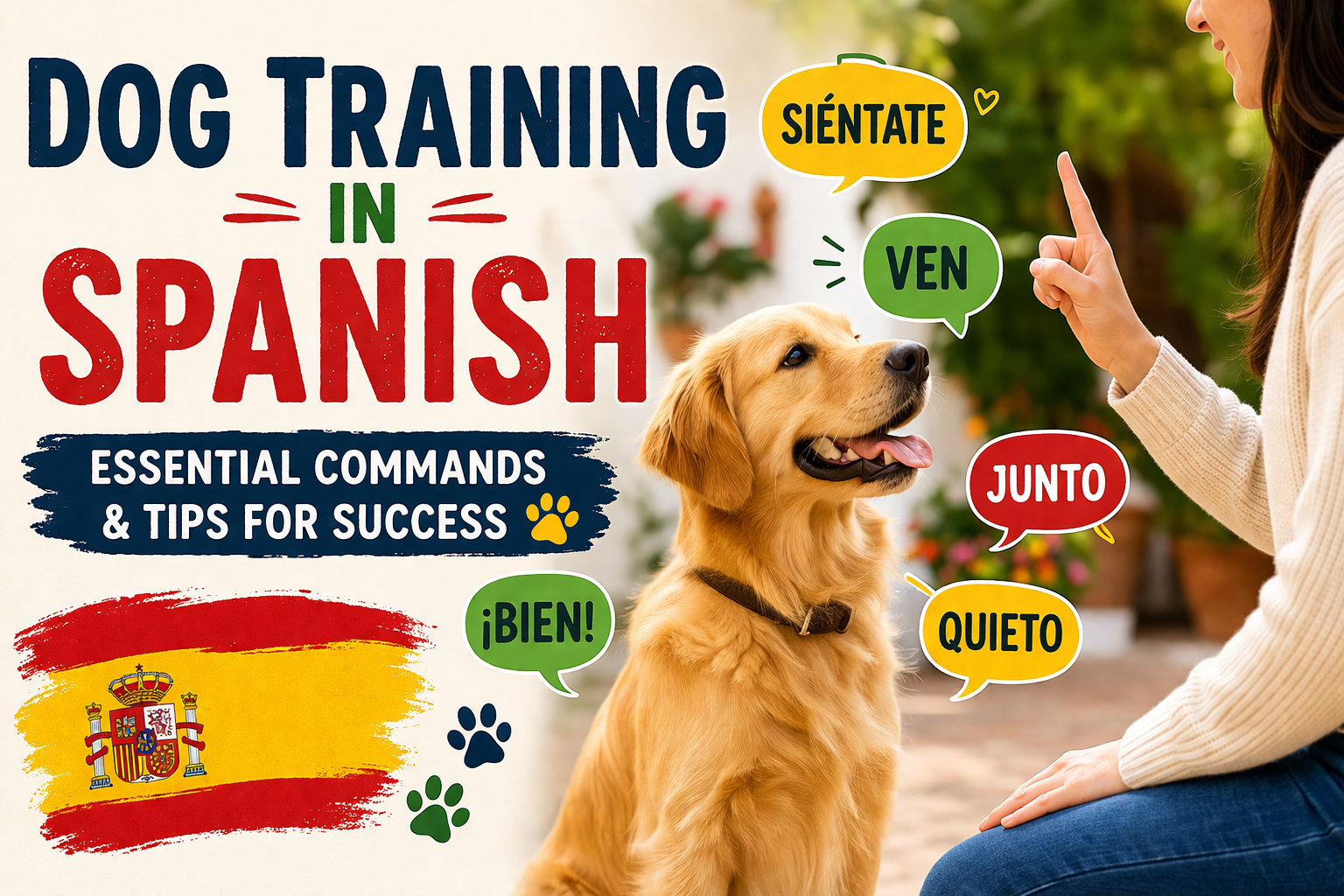
Some of you may have come across videos titled “Dogs understand English.” They’re quite engaging and often show our furry friends reacting as if they understand exactly what their owners are saying, even outside of formal training. There’s no doubt that dogs are incredibly intelligent, and their potential can truly amaze us, especially when we put in the time and effort to develop it.
But does training and communication with our dogs always have to be in English? What about other languages, like Spanish? In fact, around 600 million people worldwide speak Spanish. It is the second most widely spoken native language and also ranks second overall when including people who speak it as a second language.
With that said, it’s no surprise that many people choose to train their dogs in Spanish. Beyond its global popularity, you might be wondering if there are other reasons to use it as your dog’s “training language.” Let’s find out!
Why Use Spanish Commands for Dogs?
One of the main advantages of using Spanish commands is how clearly they stand out from everyday speech. Dogs are always tuned in, even when we’re not aware of it.
When they repeatedly hear common command words in casual situations, those words can start to lose their meaning. They become part of the background rather than a clear cue. Using Spanish can help avoid this, as those words are only used when you truly intend to give a command.
Of course, this doesn’t mean you should stop training your dog in English or your mother tongue but using specific cues in a different language can definitely make training more consistent, especially in households with multiple people.
In everyday situations, it’s common for each person to phrase commands slightly differently, whether it’s “come,” “come here,” or something else entirely. While these differences seem small to us, they can be confusing for our dogs. Sticking to a specific set of Spanish commands can help create consistency, where each word has one clear meaning and is used the same way every time.
Another benefit becomes more noticeable in public or more advanced training scenarios. You may not want your dog responding to every voice they hear around them. Dogs trained with common English commands can sometimes react when strangers use familiar words without realizing it. With Spanish, this is far less likely to happen, which gives you more control and helps your dog stay focused on you.
This is one of the reasons Spanish has been widely used in professional and working dog training. It keeps communication simple, clear, and consistent between the dog and their handler. Ultimately, the goal isn’t the language itself, but the clarity it brings. When your canine can easily understand what you’re asking, training becomes smoother and more reliable.
Basic Dog Commands in Spanish
Whether you’ve decided to train your dog to ensure they are a well-mannered and socialized family member or if you’re pursuing advanced training, such as service dog training, you should start with the basics. These commands form the foundation of clear communication and specialized training in the future. Whether you’re working with a puppy or an older dog, these cues are the ones you’ll use every day.
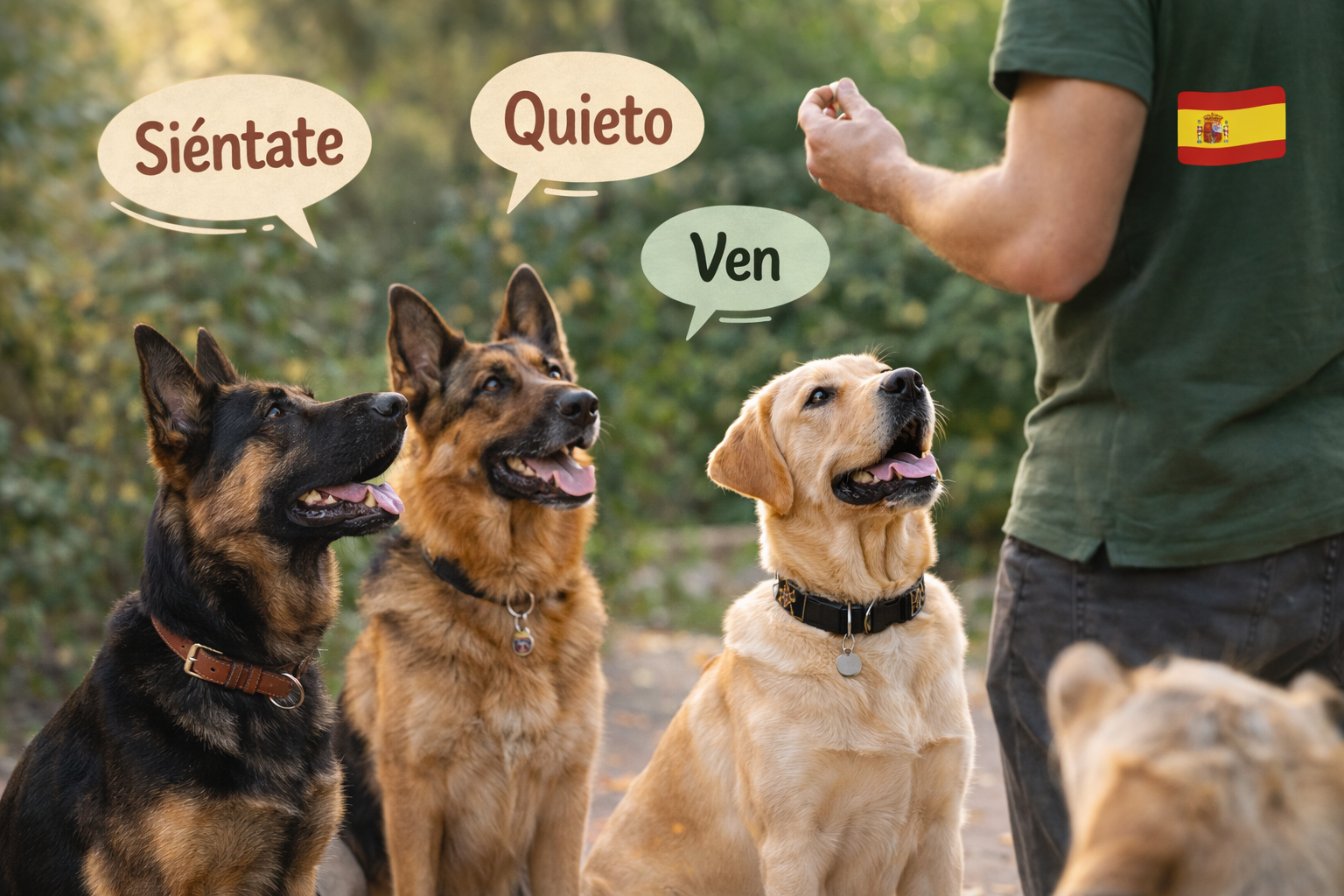
Sit, “Siéntate”
This is usually one of the first commands dogs learn. It’s simple, practical, and helps create calm behavior in many situations, whether you’re greeting someone, preparing food, or just asking your dog to settle.
Stay, “Quieto” / “Quieta”
“Quieto” is used to ask your dog to hold their position until released. While Spanish distinguishes between “quieto” (masculine) and “quieta” (feminine), most trainers use one consistent cue, regardless of the dog’s gender. It’s especially useful for building patience and self-control, and it becomes more important as you start training in busier environments.
Wait, “Espera”
Similar to English, where ‘stay’ is used for longer periods and ‘wait’ for shorter pauses, the Spanish word “Espera” is slightly different from “Quieto” / “Quieta”. It’s often used for short pauses, like waiting at a door, before crossing the street, or before being released to eat.
Come / Come here, “Ven” / “Ven aquí”
Recall is one of the most important skills for any dog. “Ven” is short and direct and means “come”, while “Ven aquí” can feel a bit more inviting. Both work well, as long as you stay consistent and make coming to you a positive experience.
Down, “Échate” / “Abajo”
When it comes to the command “down”, Spanish offers more than one option, so, it’s important to understand the difference to make your training clearer.
“Échate” (or “echado”) is commonly used to ask a dog to lie down. It’s often associated with a more relaxed position, especially when you want your dog to settle and remain in place for a longer period of time.
On the other hand, “abajo” can also mean “down,” but it is more flexible in its use. Many trainers use it not only to ask a dog to lie down, but also to tell the dog to get off something, such as furniture or a person.
Because of this overlap, using “abajo” for both meanings can sometimes lead to confusion. For that reason, many trainers prefer to keep things clear by using “échate” specifically for lying down, and reserving “abajo” or even “fuera” for situations where the dog needs to get off or move away from something.
Heel, “Junto”
“Junto” asks your dog to walk calmly by your side. It’s especially helpful during walks in busy areas, where you need your dog to stay close and focused.
No, “No”
Simple and universal, “No” is used to interrupt unwanted behavior. The key here is timing and tone, keeping it calm and clear rather than harsh or emotional.
Good job, “Bien” or “Muy bien”
Positive feedback is just as important as commands! The cue words “Bien” or “Muy bien” let your dog know they’ve done the right thing and help reinforce good behavior. Positive reinforcement also helps build their confidence, which is essential for helping them become reliable, well-balanced, and enjoy learning.
Intermediate Commands in Spanish
Once your dog is comfortable with the basics, you can start adding more specific commands that improve control and responsiveness in everyday situations.
Leave it, “Déjalo”
This tells your dog to ignore something, whether it’s food on the ground or an object they shouldn’t pick up. It’s a helpful command for both safety and impulse control.
Drop it, “Suelta”
“Suelta” is used when your dog already has something in their mouth and you want them to release it. Teaching this properly can prevent resource guarding and make playtime smoother.
Go to your spot, “A tu lugar”
This directs your dog to a specific spot, such as their bed or mat. It’s especially useful at home when you want your dog to settle while you’re busy or when guests arrive.
Fetch, “Trae”
“Trae” encourages your dog to bring an item back to you. While it often starts as a game, it can also become a useful skill for retrieving objects on cue.
Advanced & Service Dog Commands in Spanish
These commands go beyond everyday obedience and are often used in more specialized training, such as service dog training. They require a solid foundation and consistent practice.
Focus/look at me, “Mírame”
“Mírame” asks your dog to make eye contact and focus on you. This is especially helpful in distracting environments, as it brings your dog’s attention back to you quickly.
Find/search, “Busca”
This command encourages your dog to use their nose to locate something, whether it’s an object, a person, or even a specific scent. It taps into a dog’s natural abilities and can be both if you’re engaged in scent training, while also being mentally stimulating.
Help/assist, “Ayuda”
For service dogs, “Ayuda” can be used as a cue to perform a trained task. This might include retrieving items, providing physical support, or responding to a specific need.
Kiss / Give a kiss, “Beso” / “Dame un beso”
This cue encourages the dog to gently lick the handler. It can be used as a form of tactile stimulation for a calming effect, for example, as an interruption during moments of stress or dissociation. Giving a kiss is a common task for psychiatric service dogs.
Nose-nudge, “Toca” or “Empuja”
“Toca” (touch) is commonly used to ask the dog to make contact with their nose, usually targeting the handler’s hand or body. This can be used to redirect attention, interrupt behaviors, or prompt the handler to respond to something important.
How to Teach Spanish Commands
Introducing Spanish commands doesn’t mean you have to replace the cues your dog already knows. In many cases, it’s best to keep what’s working and simply decide how you want to use the new language as you move forward with training. For example, some handlers choose to use Spanish from the very beginning, while others use it alongside existing commands, as long as they remain consistent in their approach.
If your dog already responds reliably to English cues, you can still introduce Spanish as an additional layer. The key is to do this in a way that keeps training clear and predictable for your dog, so they don’t feel like they’re being given two different commands for the same behavior.
One simple approach is to pair the Spanish word with the known command, such as saying “sit, siéntate,” and rewarding your dog when they respond. At this stage, the familiar English cue helps guide the behavior, while the Spanish word starts to build meaning through repetition and association.
To avoid confusion, make sure you always use the same pairing and keep your timing consistent. Say the words clearly, use the same tone each time, and reward immediately when your dog gets it right. Short and focused sessions work best, as they give your dog time to process the new cue without becoming overwhelmed.
Over time, your dog may begin to recognize both cues. You might notice them responding just as quickly to the Spanish word, even before you finish the English one. From there, you can decide what works best for you, whether that’s continuing to use both or naturally leaning more toward one of them. Remember to keep everything consistent and easy for your dog to follow.
Treats and positive reinforcement make this process much smoother. When your dog responds correctly, reward them right away so they can clearly connect the word with the action. Praise them, such as “bien” or “muy bien,” to help reinforce the behavior.
Repetition is important, but it doesn’t have to feel repetitive. Short, consistent training sessions tend to be more effective than long ones. The more your dog hears the same word used in the same way, the easier it becomes for them to understand and respond.
Whether you stick with one language or use both, what matters most is that each command remains clear, predictable, and easy for your dog to recognize.

Common Mistakes to Avoid
One of the most common mistakes is mixing languages without a clear plan. If you switch between English and Spanish randomly, your dog may struggle to understand which word actually matters. It’s much easier for them when each command has one consistent cue.
Another issue is changing commands too quickly. If your dog hasn’t fully learned the new word yet, dropping the old one too soon can lead to confusion. Instead, you should overlap them for a while and fade one out gradually.
Using long or unclear phrases can also make the process harder than it should be. Dogs respond best to short and distinct words, not full sentences. That said, try to keep your cues simple so that they are easy to recognize and remember.
Timing is another important factor to consider. If you reward your canine too soon or too late, they may not connect the reward with the behavior you’re trying to reinforce. Make sure to give a reward and praise them right after they’ve responded to the given cue or performed the wanted task. Clear timing helps them understand exactly what they did right, which helps accelerate the learning process.
Tips for Success
As you may have already learned, it’s important to keep your commands short and clear, as this will make a noticeable difference.
Generalizing behaviors, which means practicing in different settings, is another important thing to remember. Your dog may perform a command perfectly at home but become distracted in public. Therefore, gradually introducing distractions and exposing your furry friend to different situations and surroundings will help them learn to respond reliably no matter where you are.
Hand signals can be a great addition as well! Dogs are very observant and often respond just as well, if not better, to visual cues. Pairing a hand signal with your Spanish command can strengthen their understanding and also give you another way to communicate when needed.
Most importantly, focus on building reliability step by step. Before adding distractions or increasing difficulty, make sure your dog fully understands the command in a calm environment. A strong foundation makes everything that comes next much easier.
Frequently Asked Questions (FAQ)
Can any dog learn commands in Spanish?
Yes, any dog can learn commands in Spanish. Dogs don’t have a preference for one language over another. What matters is consistency, repetition, clear communication and using short and simple words.
Will it confuse my dog?
Not if it’s introduced
properly. If you pair the new Spanish commands with ones your dog
already knows and transition gradually, most dogs adapt quickly
without any confusion.
Should I switch completely or mix languages?
This depends on your goal. Some people prefer to switch entirely to keep things simple and consistent, while others use a mix. For example, in multilingual households or when a dog already knows certain commands well and the handler wants to add some extra mental stimulation. It’s essential to avoid using multiple words for the same command in a random or inconsistent way.
Great News!
Certified Intensive Psychiatric Service Dog Training Course Is Now Available in Spanish
We are excited to announce that our Certified Intensive Psychiatric Service Dog Training Course is now fully available in Spanish.
At Service Dog Training School International (SDTSI), our mission is to make professional service dog training accessible to individuals and families around the world. By launching the Spanish version of this course, we are taking another important step toward helping more Spanish-speaking handlers train their own psychiatric service dogs with confidence.
Professional Training You Can Complete from Home
Our online course is designed for individuals who wish to train their own dog to perform psychiatric service dog tasks that help mitigate symptoms related to conditions such as:
- Anxiety disorders
- Post-traumatic stress disorder (PTSD)
- Depression
- Panic disorder
- Bipolar disorder
- Autism spectrum disorder
The course is self-paced and suitable for beginners, even if you have no previous dog training experience.
What the Course Includes
Students enrolled in the Spanish-language course receive access to:
- Step-by-step psychiatric service dog task training
- Public access training and behavior standards
- ADA and legal rights education
- Behavior problem-solving lessons
- Certification preparation
- Lifetime trainer support
- Access to our private student community
The course is based on animal behavior science and positive reinforcement methods, making it both humane and effective.
Train Your Own Psychiatric Service Dog
Many people assume they must wait years and spend tens of thousands of dollars to obtain a professionally trained service dog. While professional programs can be valuable, owner-training offers an accessible and rewarding alternative.
With the right guidance, you can train the dog you already know and love to become a reliable psychiatric service dog partner.
Why Spanish-Language Access Matters
We know that learning in your native language makes a tremendous difference. By offering our course in Spanish, we hope to make service dog training more accessible to millions of Spanish-speaking handlers worldwide.
Whether you live in the United States, Latin America, Spain, or elsewhere, you can now complete the entire course in Spanish from the comfort of your home.
Start Your Training Journey Today
If you are ready to train your own psychiatric service dog, our Spanish-language course provides the structure, guidance, and professional support you need.
Your dog may already be providing comfort and companionship. With proper training, they can become a skilled service dog capable of assisting you with important daily tasks.
Enroll Today
Explore the Spanish version of our Certified Intensive Psychiatric Service Dog Training Course and begin your journey toward greater independence and confidence.
At SDTSI, we are honored to support handlers around the world—now in Spanish as well.