




- What Are Service Dogs?
- What Does the Law Say?
- Can Restaurants Charge Extra Fees for Service Dogs?
- How Can Staff Verify a Dog’s Legitimacy as a Service Animal?
- Do You Need Documentation for Your Service Dog?
- Are Restaurant Staff Required to Allow a Service Dog on a Seat?
- Misconceptions About Service Dogs
- Best Practices for Handlers
- What to Consider During International Travel?

Imagine walking into your favorite café, the smell of fresh coffee in the air, and your service dog calmly at your side! You look around, notice some curious glances from other diners, and wonder: “Am I allowed to be here with my dog?”
For many people who rely on service dogs, this is a question that comes up more often than you might think. Service dogs aren’t just pets, they’re trained companions, who help their handlers navigate daily life with confidence and independence.
But when it comes to public places, like restaurants, the rules and reactions can sometimes feel confusing.
In today’s article, we’ll explore whether service dogs are allowed in restaurants, what handlers can expect, and how both handlers and restaurants can make mealtime a smooth and positive experience.
What Are Service Dogs?
You might feel like you’ve read this definition many times, but it’s helpful to ensure we’re all on the same page. For those who are not familiar, service dogs, also called service animals, are dogs, individually trained to perform specific tasks for a person with a disability. These tasks must be directly related to that disability.
In most U.S. states, miniature horses can also be recognized as service animals.
Unlike companion animals, which provide comfort and companionship simply by being present, service dogs undergo specialized task training. This training also includes basic obedience and proper public manners, both of which are key components of the process. They help ensure a service dog team can function safely and effectively in public spaces.
What Does the Law Say?
It’s
important to be familiar with the law, whether you are a service dog
handler, a business owner, or a passerby. This knowledge helps
facilitate clear and respectful communication and prevents
misunderstandings.
In the United States, the Americans with Disabilities Act (ADA) is the federal law that protects the rights of individuals with disabilities to be accompanied by their service dogs in public spaces, including restaurants. As explained above, service dogs are not just pets. They are dogs, individually trained to do work or perform tasks directly related to a person’s disability. These tasks can include but are not limited to guiding a person with visual impairments, alerting a person with hearing loss, or interrupting anxiety episodes.
While pets are our beloved companions and family members, they do not have the same legal protections as service dogs, and restaurants can decide whether to allow them inside or not.
Companion animals, such as emotional support animals (ESAs) and therapy animals (TAs), can indeed provide significant benefits for an individual’s mental health and overall well-being. However, because these support animals provide comfort and companionship only, without undergoing specialized task-based training, they are treated as pets in public. Therefore their acceptance is at the discretion of the business owner.
If you are unsure about the difference between ESAs and TAs, here is a quick clarification.
Emotional support animals provide comfort and companionship for one person only, while therapy animals visit designated facilities such as hospitals, schools, nursing homes, or therapy practices to support multiple individuals. They assist people in recovery not only from physical injuries or trauma but also from emotional or psychological challenges. These animals can greatly contribute to improving learning, mobility, social skills, and overall well-being.
With that being said, the ADA as well as the relevant local laws, clearly distinguish between companion animals and service dogs.
Can Restaurants Charge Extra Fees for Service Dogs?
No, restaurants can not charge extra fees for service dogs. This applies even if the dog takes up extra space, sheds, or otherwise requires some accommodation.
Of course, it’s important to clarify that service dogs should appear healthy and well taken care of.
Handlers should not be asked to pay deposits, cleaning fees, or any extra charges that wouldn’t apply to other customers. The law ensures that people with disabilities have the same right to visit public places without being financially burdened for having a service dog.
Both handlers and business owners benefit from understanding this rule, as it helps avoid confusion. Handlers can feel confident bringing their service dogs to restaurants, while staff can focus on providing a positive experience for all guests.
How Can Staff Verify a Dog’s Legitimacy as a Service Animal?
Here’s what the ADA says:
“In situations where it is not obvious that the dog is a service animal, staff may ask only two specific questions:
(1) is the dog a service animal required because of a disability? And
(2) what work or task has the dog been trained to perform?
Staff are not allowed to request any documentation for the dog, require that the dog demonstrate its task, or inquire about the nature of the person’s disability”.
So, you may ask: why would I need any documentation for my service dog?
Do You Need Documentation for Your Service Dog?
Laws in some countries and regions, including the US and the UK, are clear and protective of service dog teams, stating that documentation for service animals is not legally required. However, this can be a double-edged sword. While this helps legitimate service dog teams access public products and services more easily, it also makes it easier for some individuals to falsely present their pets as service animals.
Providing a certificate as proof of training and/or ID documents for your dog, though not legally required, can help you assert your rights in public settings like restaurants. Business owners and staff are generally more welcoming toward service animals when proper documentation is available.
It’s important to note, though, that it’s the dog’s behavior that ultimately shows whether they have undergone proper training or not. Well-mannered dogs who remain focused on their handlers, even in the presence of distractions like food, have likely been properly trained.
On the other hand, a handler’s behavior can also indicate whether they and their canine are a legitimate team. Confident, knowledgeable handlers who guide their dogs calmly, follow public-access rules, and respond appropriately in distracting situations are more likely to be working with a genuine service dog.
In contrast, handlers who struggle to control their dog or seem unaware of basic expectations may raise questions about the team’s legitimacy.
Are Restaurant Staff Required to Allow a Service Dog on a Seat?
No, restaurants and other places where food or drink is served are not legally required to allow service dogs on chairs. Also, service dogs shouldn’t be fed at the table. Let’s take a closer look at what the ADA says:
“Seating, food, and drink are provided for customer use only. The ADA gives a person with a disability the right to be accompanied by his or her service animal, but covered entities are not required to allow an animal to sit or be fed at the table”.
Misconceptions About Service Dogs
Many people, including restaurant staff, may have misunderstandings about service dogs.
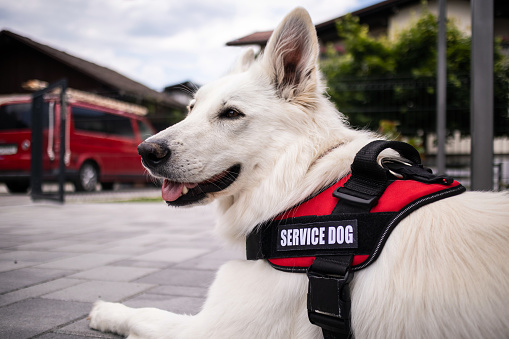
One common misconception is that any dog wearing a vest or ID is automatically a service animal. In reality, vests and badges are helpful tools but do not replace the legal protections a trained service dog has.
Another frequent myth is that service dogs must perform highly visible tasks to be legitimate. Many tasks, such as alerting to medical conditions or interrupting anxiety episodes, can be subtle but are by no means less important.
Furthermore, some people still confuse emotional support animals with service dogs, such as psychiatric service dogs, assuming they have the same access rights, which is not the case.
As already explained, emotional support animals are a type of companion animal, who provides comfort and companionship only without performing specific tasks. Psychiatric service dogs, on the other hand, are trained to perform specific tasks to help mitigate the symptoms of mental health issues such as anxiety, PTSD, bipolar disorder, depression and others.
Awareness of these misconceptions can prevent unnecessary conflicts and help create a smoother experience for both handlers and restaurant staff.
When Restaurants Can Exclude a Service Dog?
Although service dogs are allowed in public spaces, there are some circumstances in which a restaurant can legally deny access.
For example, if a dog is out of control, aggressive, or poses a direct threat to the safety of others, staff may ask the handler to take the animal outside.
Dogs that are not housebroken or cannot be reasonably accommodated without disrupting the business may also be excluded.
However, restaurants cannot refuse entry simply because of allergies, fear of dogs, or a preference for a pet-free environment. It’s essential for staff to understand these rules so they can ensure safety and convenience for guests while also respecting the legal rights of service dog teams.
Best Practices for Handlers
Going to a restaurant with your service dog can be easy and stress-free if a few simple tips are followed.
First, it’s essential to keep your dog under control at all times. A well-behaved dog should stay calm and focused on you, even with distractions like other animals or people, smells, or noises. Bringing a few treats or a small toy can help reinforce good behavior, but make sure they’re used quietly and don’t disturb anyone.
If you have any doubts about your dog’s behavior in public, it may be a good idea to practice a little bit more in pet-friendly locations before visiting public places where dogs may not be allowed.
Seating is another practical consideration. Choosing a table with a bit of extra space can make it easier for your dog to lie down comfortably without blocking walkways or other tables. Corner tables or spots against a wall can be especially helpful for minimizing distractions.
You may also consider bringing a few clean-up supplies. Even well-trained dogs can shed or have minor accidents if they’re stressed, provoked, or dealing with health issues. Having wipes or paper towels on hand shows thoughtfulness toward the restaurant and other guests.
We strongly recommend letting staff know about your service dog in advance. A short, polite explanation, including mentioning the tasks your dog has been trained to perform without going into your health details, is usually enough. Keeping it simple helps make the interaction more relaxed for everyone.
Planning ahead and communicating your needs and rights politely can make visits to restaurants easier and more enjoyable.
What to Consider During International Travel?
If you plan to travel with your service dog, it’s important to remember that rules and regulations can vary widely from country to country.
In some cases, you may be required to provide specific documentation, such as a certificate issued by a member of Assistance Dogs International (ADI), the International Guide Dog Federation (IGDF), or an accredited local training facility. Some countries may also require specific training or identification gear, so make sure to familiarize yourself with local laws before visiting public places like restaurants.
Many countries provide government resources or official guidance for travelers with service animals.
Checking the policy of a specific restaurant in advance can also help prevent unpleasant situations and ensure a smoother experience.
Consider carrying basic documentation, such as proof of your dog’s training or vaccination records, even when these are not legally required, as it may make interactions with staff or authorities easier.
Being prepared and informed will help you and your service dog navigate international travel more confidently and minimize stress for both you and those around you.